Tuesday, December 13, 2011
Yamato Wins Award at Marine Mammal Biennial
Joint Program student Maya Yamato has won the John G. Shedd Award for the Overall Best Student Presentation at the 19th Biennial Conference on the Biology of Marine Mammals. Her talk, "The auditory anatomy of the minke whale (Balaenoptera acutorostrata): Insights into potential sound reception pathways in a baleen whale," was co-authored by Darlene Ketten, Julie Arruda, Scott Cramer, and Kathleen Moore. Maya and her collaborators, "combined classical dissection with biomedical imaging techniques such as X-ray computerized tomography and magnetic resonance imaging to describe the anatomy of the minke whale head with a focus on the ear region."
Wednesday, December 7, 2011
Stocker Newest Member of JCBO
Roman Stocker, Associate Professor of Civil and Environmental Engineering at MIT, has been appointed to JCBO. Prof. Stocker's appointment began November 1, and will last for three years.
Prof. Stocker's research "focuses on the physical ecology of microorganisms and on microscale transport phenomena."
Please join me in welcoming Roman to the Joint Program.
Prof. Stocker's research "focuses on the physical ecology of microorganisms and on microscale transport phenomena."
Please join me in welcoming Roman to the Joint Program.
2012 Admissions Schedule
I can't believe another year has come and gone. A new admissions season always reminds me how fast time flies.
This year Assistant Scientist Aran Mooney will join Matt Johnson and me as the Biology Department representatives on the Admissions Advisory Committee. Aran, Matt and I will have many applications to read. If we look sleepy around the end of January, you will know why!
Here is the schedule of important admissions dates:
- January 5: Application deadline
- January 12: Files available for Admissions Committee review
- January 26: First cut by Disciplinary Committees (to approximately 15 applicants)
- January 30: Biology Department admissions meeting (cull list to approximately 10)
- February 9: Admissions Advisory Committee "Pizza" meeting
- February 14: JCBO admissions meeting
- February 16: Joint Program Committee meeting (final decisions)
- February 16: Begin notifying applicants
- March 12-13: Open House (12th at MIT, 13th at WHOI)
Monday, May 16, 2011
Biology Students Win Fellowships
![]() |
| Kristen Hunter-Cevera |
![]() |
| Harriet Alexander |
Please join me in congratulating JP Bio Students Harriet Alexander, Kristen Hunter-Cevera and Emily Moberg. Harriet and Kristen both won prestigious three-year fellowships from the Department of Defense. The National Defense Science & Engineering Graduate Fellowships are awarded to "individuals who have demonstrated the ability and special aptitude for advanced training in science and engineering."
In addition, Harriet and incoming student Emily Moberg were awarded NSF Graduate Research Fellowships. According to the website, "the reputation of the GRFP follows recipients and often helps them become life-long leaders that contribute significantly to both scientific innovation and teaching. Past fellows include numerous Nobel Prize winners, U.S. Secretary of Energy, Steven Chu, Google founder, Sergey Brin and Freakonomicsco-author, Steven Levitt."
But don't worry, Harriet, Kristen and Emily....no pressure!
Wednesday, April 20, 2011
Entering JP class of 2011 is complete!
The dust has now settled and the results are in! The entering class of 2011 is now complete. They are:
- Alexander Bergan (UC San Diego; advisors: Gareth Lawson & Andone Lavery)
- Alexis Fischer (Wellesley College; advisor: Don Anderson)
- Jesse McNichol (Mount Allison Univ.; advisor: Stefan Sievert)
- Emily Moberg (MIT; advisor: Mike Neubert)
- Julie Van der Hoop (Dalhousie Univ.; advisor: Michael Moore)
Monday, April 4, 2011
JP Student wins AGU Award
The accolades continue to accumulate for Biology JP students and postdocs. Here's news that Santiago Herrera has won an Outstanding Student Paper Award for his presentation Biodiversity of the Deep-Sea Benthic Fauna in the Sangihe-Talaud Region, Indonesia: Observations from the INDEX-SATAL 2010 Expedition. Santiago gave his presentation at the 2010 AGU Fall meeting in San Francisco. The selection committee said, "Your presentation was recognized as among the best of a strong group of student presenters, which sets an example for your fellow students and the entire AGU membership." Among the 14 co-authors were fellow JP student Eleanor Bors and Santiago's advisor, Tim Shank. You can find the abstract here. Congratulations Santiago!
Thursday, March 10, 2011
Bio Postdoc Wins Society of Toxicology Award
At the Society of Toxicology (SOT) annual meeting this week in Washington, DC, WHOI Postdoctoral Fellow Dr. Alicia Timme-Laragy won the first place award for postdoctoral research from the Molecular Biology Specialty Section of SOT. Here she is presenting her poster "Nrf2b: a novel Nrf2 paralog in zebrafish" (co-authored by S l Karchner, D G Franks, M J Jenny, and M E Hahn). Good work Alicia!
Monday, February 21, 2011
JP Biology Grad Wins ASLO Prize
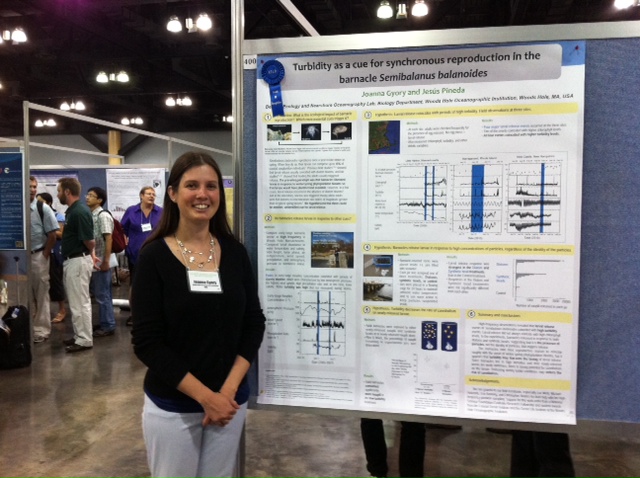
Recent MIT/WHOI Joint Program graduate Joanna Gyory has won the Best Poster Prize at this year's ASLO Aquatic Sciences Meeting for her poster "Turbidity as a cue for synchronous reproduction in the barnacle Semibalinus balanoides." The poster was coauthored by her Ph.D. advisor Jesus Pineda. Congratulations Joanna!
Friday, February 4, 2011
2011 Ocean Ventures Fund Competition
OCEAN VENTURES FUND (OVF) GUIDELINES, 2011
The Ocean Ventures Fund was created in response to the traditionally conservative and time consuming funding procedures of federal agencies. The intent of OVF is to promote hard-to- fund research and innovation by encouraging scientists to take chances in following their curiosity.
WHO IS ELIGIBLE TO APPLY:
OVF is open to all students in the MIT/WHOI Joint Graduate Program in Oceanography and Oceanographic Engineering. The research idea and the proposal text must come from the graduate students, not his/her supervisor. Students are the Principal Investigators. Both disciplinary and interdisciplinary proposals are encouraged, as are projects relating to EPA- funded research.
CALENDAR:
The submission deadline for OVF proposals is April 1, 2011. Proposals will be reviewed during April 2011 by the WHOI Education Coordinators, Dean, and Associate Dean. Award decisions will be made and notices will be sent in May for research start-up on June 1, 2011. At least 8 awards may be given in 2011.
PROPOSAL FORMAT:
With the exception of the following, OVF proposals should follow NSF guidelines. The explanatory text may not exceed four pages (maximum of six with illustrations). A cover letter must recap the proposal in lay person's terms and include reasons for applying to OVF. Remember to state clearly the research objective and why it is important.
The OVF Proposal must include the following sections in this order: 1. Cover letter, no longer than one page. 2. Endorsement letter, no longer than one page, from student's advisor. 3. Title page with abstract, including signatures of department chair and advisor. 4. Explanatory text, not to exceed four pages (excluding figures). 5. Bibliography. 6. Budget; should not exceed $15,000.00. 7. Curriculum Vitae. 8. Please provide the proposal in hard copy and pdf format to your Education Coordinator.
BUDGET:
Budgets may be used be for your stipend, if you are unsupported by a research grant. Salary support for technical assistance may also be included, as well as cost of equipment, supplies, travel, and computer time. Budgets must be calculated using WHOI (i.e., not MIT) rates.
EVALUATION:
Proposals are judged on: 1. Quality of science and how clearly you express it. 2. Appropriateness for funding by OVF, as opposed to funding by conventional research sources.
Education Coordinators: Biology, Mike Neubert; MC&G, Mark Kurz; G&G, Delia Oppo; AOPE, Tim Stanton; Physics, Steve Lentz
The Ocean Ventures Fund was created in response to the traditionally conservative and time consuming funding procedures of federal agencies. The intent of OVF is to promote hard-to- fund research and innovation by encouraging scientists to take chances in following their curiosity.
WHO IS ELIGIBLE TO APPLY:
OVF is open to all students in the MIT/WHOI Joint Graduate Program in Oceanography and Oceanographic Engineering. The research idea and the proposal text must come from the graduate students, not his/her supervisor. Students are the Principal Investigators. Both disciplinary and interdisciplinary proposals are encouraged, as are projects relating to EPA- funded research.
CALENDAR:
The submission deadline for OVF proposals is April 1, 2011. Proposals will be reviewed during April 2011 by the WHOI Education Coordinators, Dean, and Associate Dean. Award decisions will be made and notices will be sent in May for research start-up on June 1, 2011. At least 8 awards may be given in 2011.
PROPOSAL FORMAT:
With the exception of the following, OVF proposals should follow NSF guidelines. The explanatory text may not exceed four pages (maximum of six with illustrations). A cover letter must recap the proposal in lay person's terms and include reasons for applying to OVF. Remember to state clearly the research objective and why it is important.
The OVF Proposal must include the following sections in this order: 1. Cover letter, no longer than one page. 2. Endorsement letter, no longer than one page, from student's advisor. 3. Title page with abstract, including signatures of department chair and advisor. 4. Explanatory text, not to exceed four pages (excluding figures). 5. Bibliography. 6. Budget; should not exceed $15,000.00. 7. Curriculum Vitae. 8. Please provide the proposal in hard copy and pdf format to your Education Coordinator.
BUDGET:
Budgets may be used be for your stipend, if you are unsupported by a research grant. Salary support for technical assistance may also be included, as well as cost of equipment, supplies, travel, and computer time. Budgets must be calculated using WHOI (i.e., not MIT) rates.
EVALUATION:
Proposals are judged on: 1. Quality of science and how clearly you express it. 2. Appropriateness for funding by OVF, as opposed to funding by conventional research sources.
Submit your proposals, by April 1, to your education coordinator.
Education Coordinators: Biology, Mike Neubert; MC&G, Mark Kurz; G&G, Delia Oppo; AOPE, Tim Stanton; Physics, Steve Lentz
Monday, November 29, 2010
New Faces
The students of the entering class of 2010 have now almost completed their first semester in the Joint Program. With the change in season, they will soon begin their migration phase, moving frequently between Cambridge and Woods Hole. Here are their faces...why not introduce yourself if you see them?
![]() |
| Emily Brownlee Sosik Lab |
![]() |
| Esther Shyu Caswell Lab |
![]() |
| Katherine Pitz Anderson Lab |
![]() |
| Nicholas Macfarlane Tyack Lab |
|
| Harriet Alexander Dhyrman Lab |
![]() |
| Oscar Sosa DeLong Lab |
![]() |
| Jeanette Wheeler Mullineaux & Helfrich Labs |
![]() |
| Eleanor Bors Shank Lab |
Wednesday, October 27, 2010
New Student Representatives on Education Assembly
Li Ling Hamady and Skylar Bayer have been elected by their fellow JP students to represent them on WHOI's Educational Assembly. Thank you Li Ling and Skylar for agreeing to serve!
As the official "discipline representative" for the Biology Department, Li Ling will also be helping me with a variety of tasks, including finding peer mentors for the new students. I encourage senior students to participate, and first year students to not be shy about asking questions of your mentors about navigating the Joint Program.
2011 Admissions Schedule
The 2011 Joint Program Admissions season is right around the corner, and I'm anticipating another record year for the number of applications. (Great for the JP; not so great for my sleep schedule!) Assistant Scientist Matt Johnson has recently been appointed to the Admissions Advisory Committee, joining Lauren Mullineaux and me as representatives of the Biology Department.
Please mark your calendars with the following important dates:
- January 5: Application deadline
- January 12: Files available for Admissions Committee review
- January 26: First cut
- January 31: Biology Department admissions meeting
- February 10: Admissions Advisory Committee "Pizza" meeting
- February 11: JCBO admissions meeting
- February 18: Joint Program Committee meeting
- March 14-15: Open House
Friday, September 3, 2010
NSF Graduate Research Fellowships
The 2011 NSF Graduate Research Fellowship Program (GRFP) competition is now open. Some of the deadlines are:
- November 15, 2010 (Monday): Interdisciplinary Fields
- November 19, 2010 (Friday): Geosciences
- November 22, 2010 (Monday): Life Sciences
- are currently in your final year of your undergraduate program
- finished your baccalaureate degree and are planning to attend graduate school in Fall 2011
- are a first year graduate student (started in Fall 2010), or
- are in the first semester of your second year in graduate school (started Fall 2009)...
you are within the eligible amount of completed graduate study. As long as you are pursuing a research-focused Master's or PhD in an NSF-supported field and meet the citizenship requirements, you are eligible for the GRFP."
Wednesday, September 1, 2010
Handbook Update
At its last meeting, JCBO approved a small change to the curriculum. Students are now highly encouraged to take 7.410 Applied Statistics in order to satisfy their statistics requirement. They will need to petition for any course substitution. The course is being offered in the Spring so that students may enroll during the same semester that they take Biological Oceanography in Woods Hole.
This change to the curriculum is reflected in the updated Handbook for Students and Advisors, which also includes minor format changes (e.g., the links should work again).
Monday, July 19, 2010
What Is "Accepted Scientific Practice"?
The following report was sent to me by Hal Caswell:
As most everyone knows, in 2009 a number of email messages among climate researchers were stolen from the University of East Anglia. One of the researchers was Dr. Michael Mann at Penn State University. Mann was accused of various kinds of academic misconduct; Penn State carried out an investigation and found no evidence to support the allegations. However, they generated another investigation aimed not at academic misconduct (faking data, etc.), but rather at the more difficult issue of whether Dr. Mann followed "accepted scientific practices" in his conduct. This is more difficult because it involves figuring out what "accepted scientific practices" actually are.
The report of that investigation has recently been released. There is an outstanding 3-part discussion of the report on the blog Adventures in Ethics and Science, with lots of links to the official reports and to other sources for this important investigation. As part of their task, the investigators interviewed several scientists to get their opinions about accepted practice; one of those was WHOI's own Bill Curry.
Here are the links: Part 1, Part 2, Part 3.
As most everyone knows, in 2009 a number of email messages among climate researchers were stolen from the University of East Anglia. One of the researchers was Dr. Michael Mann at Penn State University. Mann was accused of various kinds of academic misconduct; Penn State carried out an investigation and found no evidence to support the allegations. However, they generated another investigation aimed not at academic misconduct (faking data, etc.), but rather at the more difficult issue of whether Dr. Mann followed "accepted scientific practices" in his conduct. This is more difficult because it involves figuring out what "accepted scientific practices" actually are.
The report of that investigation has recently been released. There is an outstanding 3-part discussion of the report on the blog Adventures in Ethics and Science, with lots of links to the official reports and to other sources for this important investigation. As part of their task, the investigators interviewed several scientists to get their opinions about accepted practice; one of those was WHOI's own Bill Curry.
Here are the links: Part 1, Part 2, Part 3.
Thursday, July 15, 2010
Joint Program Summer Picnic
The Annual Joint Program Summer Picnic took place on Saturday, July 10 on the Quissett ball field. This year’s picnic was organized by JP student representatives Claire Pontbriand (G&G) and Maya Yamato (Biology). Maya reports that the event was a smashing success:
This year’s picnic was nothing like the ones that the Joint Program has ever seen before. In an effort to raise awareness about WHOI on the MIT campus, meet new people, and show off our beautiful campus to non-JP MIT students, we chartered 2 buses to provide round-trip transportation from MIT to the Quissett ball field. We got a tremendous response, with the 106 event tickets selling out two weeks in advance and more MIT graduate students emailing us constantly asking us if they could come crash the event. (Unfortunately, we had to turn them down).
Despite the ominous weather forecast, it turned out to be a beautiful, sunny day. We fired up the grills, had lunch, and had a MIT vs. Joint Program kickball match. This was followed by soccer, Frisbee, basketball, and a trip to the beach across the street. The MIT students were excited to see our other campus, get to know more about the Joint Program, and, needless to say, incredibly jealous. The picnic was a huge success and we definitely accomplished our mission to increase awareness about our great institution. The next time we meet fellow graduate students at MIT, they might not need an explanation about WHOI or the Joint Program!
Participants included Joint Program students and MIT students from the following groups: EECS, MechE, EAPS, Biology, Biological Engineering, MIT-SRP, MTL-summership, Physics, PAOC, Aero/Astro, Technology and Policy, Nuclear Science and Engineering, and CSAIL. Funding was generously provided by the MIT Student Activities Office, MIT Graduate Student Council Funding Board, the MIT Biology Department, the MIT Graduate Association of Mechanical Engineers, the MIT Electrical Engineering and Computer Science Graduate Students Association, the MIT Earth, Atmospheric, and Planetary Science Graduate Student Advisory Council, and the WHOI Academic Programs Office.
Monday, July 12, 2010
Q & A with Prof. Paola Rizzoli
![]() |
| Photo by Ed Quinn. |
Given the ongoing discussion about how to strengthen the Joint Program, I thought it would be useful to find out a little about Paola's history of involvement, and to get her opinions about how the program might be improved. To that end, she graciously agreed to answer a few questions via e-mail:
You have just stepped down from your position as the Director of the Joint Program at MIT after 12 years of service. How did you first become involved with the Joint Program, and how has your involvement changed over the years?
When I came to MIT in 1981, all the students in oceanography were enrolled in the Joint Program, the only way for a student to get an education and degree in oceanography (all disciplines) was to apply to the Joint Program, even though technically the two Institutions, MIT and WHOI, could issue separate degrees. It was therefore natural for any new professor in oceanography to become actively involved in the Program for getting students and teaching.
Also, a fundamental motivation was the interaction with the WHOI colleagues fostered by common research interests which very often led to co-advising a student. I became immediately involved both in advising and teaching and over the years I have taught all the core courses in PO, more than once, plus other courses I designed myself on topics related to my research.
In the 90's a parallel program was created at MIT, PAOC (Program in Amosphere, Oceans and Climate ) which can give an MIT-only degree in Oceanography. PAOC at first was competitive with the JP and created considerable friction between the two Institutions (see Review Committee report of 1998). Over the years, however, the coexistence of the two Programs smoothed out; presently the JP students in Physical and Chemical Oceanography are automatically part of PAOC and basically all the PO and CO students are enrolled in the JP.
Over the years my involvement extended to the programmatic aspects of the program. I became a member of JCPO in the early 90's, and was its chair in the period 1995-1997. At that time, we restructured the PO curriculum and general exam. And finally in 1997 I became MIT Director of the entire Program. So you could say that I have spent my entire professional life at MIT (30 years in 2011....) in the Program.
How has the Joint Program changed since you first became involved?
The organizational structure is basically the same, centered around five Committees, one for each oceanographic sub-discipline. At MIT, the line "of command" changed over the years. In 1997 I was reporting to David Litster, I do not even remember which was his exact position, and he was completely indifferent to the Program. Then, when the position of the Chancellor was created, I reported to him, and Larry Bacow was the first high level governance official at MIT to pay serious attention to the Program. Then the Provost Bob Brown became very strong supporter of the JP (in 2004, at the time of the second review, Bob described the program as "a jewel in the crown of graduate studies at MIT"). Under Bob my "boss" became the Associate Provost for Research and Education, and the present one, Claude Canizares, is also a great supporter of the Program.
This has been really a great change at MIT over 12 years. From the point of view of research and interests of the faculty of the two Institutions, there was unfortunately a drift apart between the two which has been recognized and is presently being addressed.
Indeed a recent review of the the Joint Program advised that we need to reinvigorate the connection between MIT and WHOI. Why do you think the connection has withered? What one thing might we do to help revitalize it?
There are a variety of reasons why the connection between MIT and WHOI withered and they are mostly discipline-related. For example, in geophysics, at MIT we lost a number of key faculty members, such as Sean Solomon and Marcha McNutt, who had been deeply involved in the JP. They were not replaced until the recent, vigorous hiring by Maria Zuber of new young faculty in all disciplines. Thus the ties in geophysics suffered greatly by these losses. Hopefully the new geophysics MIT faculty will establish vigorous ties with the WHOI faculty.
In PO and CO the reason was due to the drift apart of the research interests of the two faculties, especially in PO (see the creation of PAOC). At MIT we evolved very strongly to climate research, which is by nature multidisciplinary and interdisciplinary. WHOI was rather resistant to such an evolution until recently. WHOI recognized the importance of such a change from more traditional oceanography by hiring as Director Susan Avery, an atmospheric and climate scientist. As Susan recalled at the June 5 commencement at WHOI, we had lunch together in Summer 2008 just a few months after she took over, and we talked about restructuring the Program towards climate oriented research. And recently WHOI has been looking for new hires in climate. The restructuring of the JP is occurring now in response to the last review report.
Another issue highlighted in the external review is the perception that students face too many hurdles if they want to undertake interdisciplinary studies in the Joint Program. Do you think that perception is correct? If so, do you think we can (or should) do something to facilitate interdisciplinary studies?
That perception was correct until recently, but the situation is changing. I will give you the PO example. Even though on paper there were three or four interdisciplinary curricula available to the students, the general exam in PO was, and is, still structured around GFD questions, even though we adjust them in the case of a student working at interdisciplinary research. The PO faculty has amply recognized this rigidity and a committee has been created and is presently working at restructuring the PO curriculum and general exam to reflect the importance of interdisciplinary studies.
The need of restructuring the entire JP, as recommended by the review committee, has been addressed through the creation by Susan Avery and Ed Boyle, of a Committee comprising MIT/WHOI faculty in all the disciplines. This restructuring process will also hopefully address the need of reinvigorating the ties between the two Institutions by creating new venues of interactions at the research and teaching/advising levels.
Is there anything you would like to say current students?
You are in one of the two top educational programs in oceanography in the world, and the only one which joins together a top sea-going institution and the top school in science and technology in the world. Take full advantage of the wide-ranging opportunities that each Institution offers; don't be shy in your ambitions. Reach out to the joint faculty: they are there to work with you and will only be delighted to help you in your research and to achieve your career goals.
Tuesday, June 22, 2010
Tyack on TEDTalks
Many of us in the Biology Department participate in educational activities outside of the Institution. One such activity is to deliver a lecture for a public audience. Unfortunately, those of us back home in Woods Hole rarely have the opportunity to see, hear, and learn from those presentations.
That's why I was delighted when Hal Caswell pointed me to a lecture that Peter Tyack gave recently as part of the TEDTalks series (posted below). After you've watched Peter's lecture, I recommend checking out other TED talks, they are great for procrastinating!
Thursday, June 10, 2010
2010 Commencement Ceremonies
Commencement ceremonies honoring graduates from the MIT/WHOI Joint Program who earned their degrees between February 2006 and June 2010 were held at McKee Ball Field in Woods Hole on Saturday, June 5. An early-morning deluge threatened to dampen the participants, if not their spirits, but the sun broke through just in time to keep all but their feet dry.
The 2010 graduates in Biological Oceanography included:
- Elizabeth Orchard, Ph.D., Phosphorus Physiology of the Marine Cyanobacterium Trichodesmium,
- Sarah Pacocha Preheim, Ph.D., Ecology and Population Structure of Vibrionaceae in the Coastal Ocean,
- Kelly Rakow Sutherland, Ph.D., Form, Function and Flow in the Plankton: Jet Propulsion and Filtration by Pelagic Tunicates,
- Erin Banning, Ph.D., Biology and Potential Biogeochemical Impacts of Novel Predatory Flavobacteria, and
- Holly Moeller, M.S., On the Economic Optimality of Marine Reserves When Fishing Damages Habitat.
- Michael Brosnahan in the category of Biological Oceanography for his 2010 paper, "Outbreeding lethality between toxic Group I and nontoxic Group III Alexandrium tamarense spp. isolates: Predominance of heterotypic encystment and implications for mating interactions and biogeography," [Deep-Sea Research II, 57:175-189], and to
- Gareth Lawson in the Interdisciplinary Papers category for his 2008 two paper set "Euphausiid distribution along the Western Antarctic Peninsula—Part A: Development of robust multi-frequency acoustic techniques to identify euphausiid aggregations and quantify euphausiid size, abundance, and biomass," [Deep-Sea Research II, 55:412-431], and "Euphausiid distribution along the Western Antarctic Peninsula—Part B: Distribution of euphausiid aggregations and biomass, and associations with environmental features," [Deep-Sea Research II, 55:432-454].
Congratulations to all the graduates and honorees, and special thanks to everyone in the Academic Programs Office who helped to make this splendid quinquennial celebration so enjoyable!
![]() |
| From left: Mark Hahn, Joy Lapseritis, Kristen Whalen, Michael Neubert and Larry Madin. (Photo by Jayne Doucette, WHOI.) |
Thursday, June 3, 2010
2010-2011 Topics Courses
JCBO has approved the following Topics Courses for the 2010-211 academic year:
Fall
Fall
- 7.431 Topics in Marine Ecology: The Biology and Ecology of Coastal Ecosystems in Tropical Oceans (Tarrant, Pineda, Thorrold)
- 7.430 Topics in Quantitative Marine Science: Dynamic Models in Biology (Neubert)
- 7.438 Topics in the Behavior of Marine Animals: Marine Animal Behavior (Sayigh)
- 7.433 Topics in Biological Oceanography: Historical Developments in Biological Oceanography (Lawson, Sosik)
Subscribe to:
Posts (Atom)